- Index
- >Projects
- >Projects in progress
- >DIGIT-MH
DIGIT-MH
Evaluation of a Digital Non-Pharmacological Intervention Combining a Physical-Cognitive Exergame and Mindfulness in Huntington’s Disease
Group : Information, Signal, Image and Life Sciences
Labelling: none
Duration: 36 months
Funding: Direction Générale de l’Offre de Soins – Fondation Maladies Rares
Staff involved from LARIS: Mickael DINOMAIS, Pauline ALI, Anne HUMEAU-HEURTIER
Project partners: Centre de Référence des Maladies Neurogénétiques du CHU d’Angers, le Laboratoire de Psychologie des Pays de la Loire (LPPL), le Laboratoire Motricité, Interactions, Performance (MIP - UR4334) site du Mans, l'Université du Québec à Rimouski, Le Centre d’études et de recherche en informatique et communications (Cédric - EA4629)
Huntington’s Disease
Huntington’s disease (HD) is a rare neurodegenerative disease with autosomal dominant inheritance typically manifests between the ages of 30 and 50. It affects approximately 5 to 10 people per 100,000 residents, with nearly 6,000 patients in France. From a neuropathological perspective, HD is characterized by progressive neurodegeneration, primarily affecting the striatum but also involving other brain regions as the disease progresses. This impairment is accompanied by changes in the corticostriatal and fronto-striatal circuits, which are essential for motor, cognitive, and emotional functions.
At present, the management of HD remains largely inadequate. Available pharmacological treatments primarily target motor symptoms, while no effective therapeutic options exist for cognitive impairments. Treatments for neuropsychiatric disorders are largely based on empirical prescribing practices, with limited evidence. Antidepressants (Selective Serotonin Reuptake Inhibitors (SSRIs), Serotonin and Norepinephrine Inhibitors (SNRIs)) may improve some symptoms, but their overall efficacy remains modest, particularly for major depressive episodes associated with HD, and no validated treatment exists for apathy.
Nonpharmacological interventions represent a promising approach, but they remain underdeveloped and under-evaluated. Adapted physical activity (APA) appears to be a particularly relevant nonpharmacological intervention in the management of Huntington’s disease. Available data show that APA is feasible, well tolerated, and associated with improvements in motor performance, particularly in balance, walking, and endurance.
The project
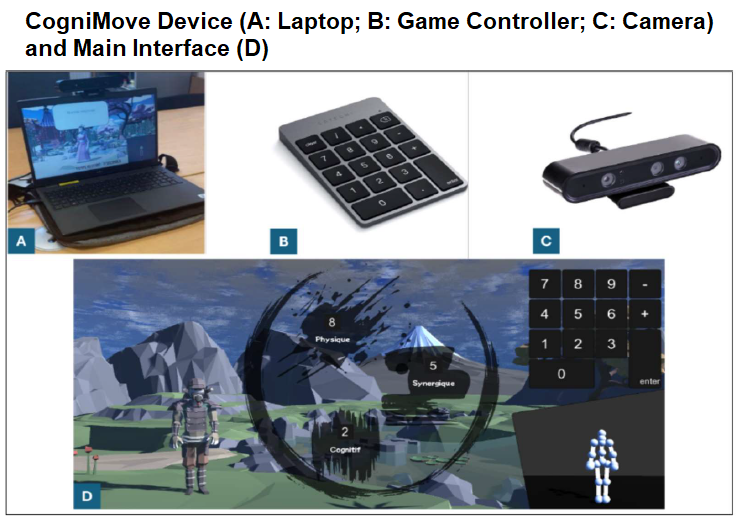
Exergames (exercise games) are interactive digital devices that combine physical activity with game-like elements, in which body movements serve as the primary mode of interaction. They allow users to combine tailored physical activity with cognitive challenges within an interactive and motivating environment, thereby promoting adherence and regular participation.
The objective of this project is to evaluate the effectiveness of an integrated digital non-pharmacological program combining a physical-cognitive exergame (Cogni-Move) with mindfulness to assess quality of life, cognitive function, and neuropsychiatric symptoms in patients with Huntington’s disease, compared to an intervention based solely on adapted physical activity.
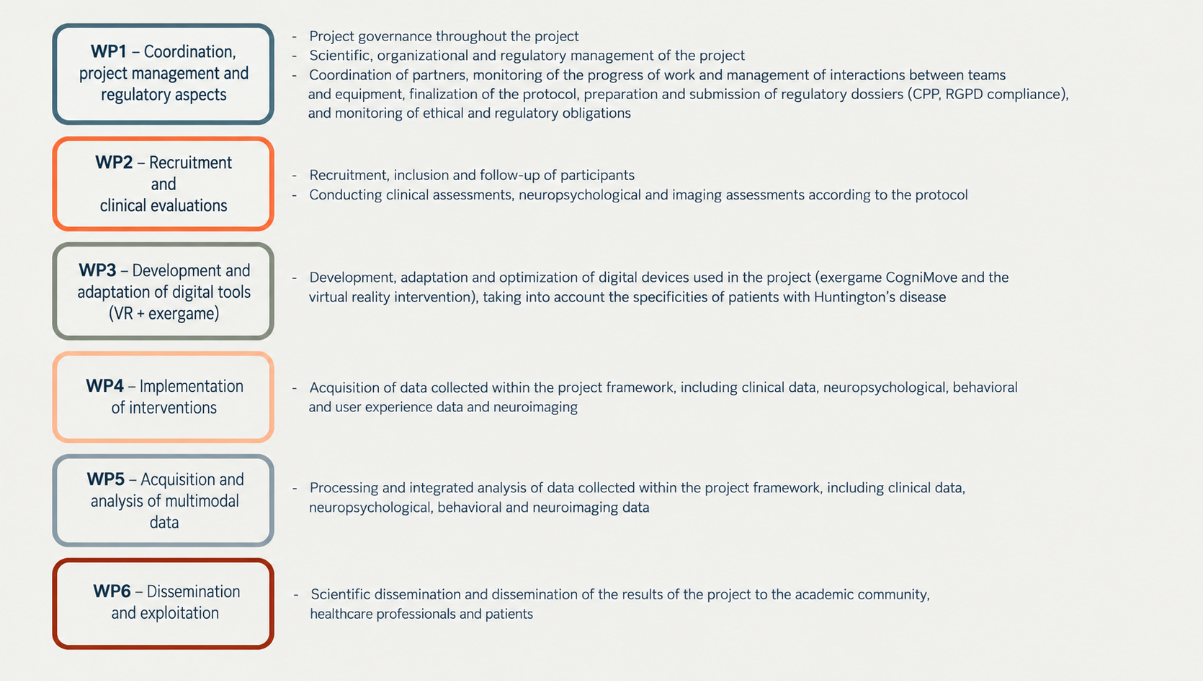
To achieve this, the project will rely on a multidisciplinary collaboration involving six partners with complementary expertise, covering all aspects necessary for its implementation: clinical, neuropsychological, technological, and interventional. This complementarity ensures the project’s scientific relevance, operational feasibility, and translational potential. It will be structured around six work packages (WP):